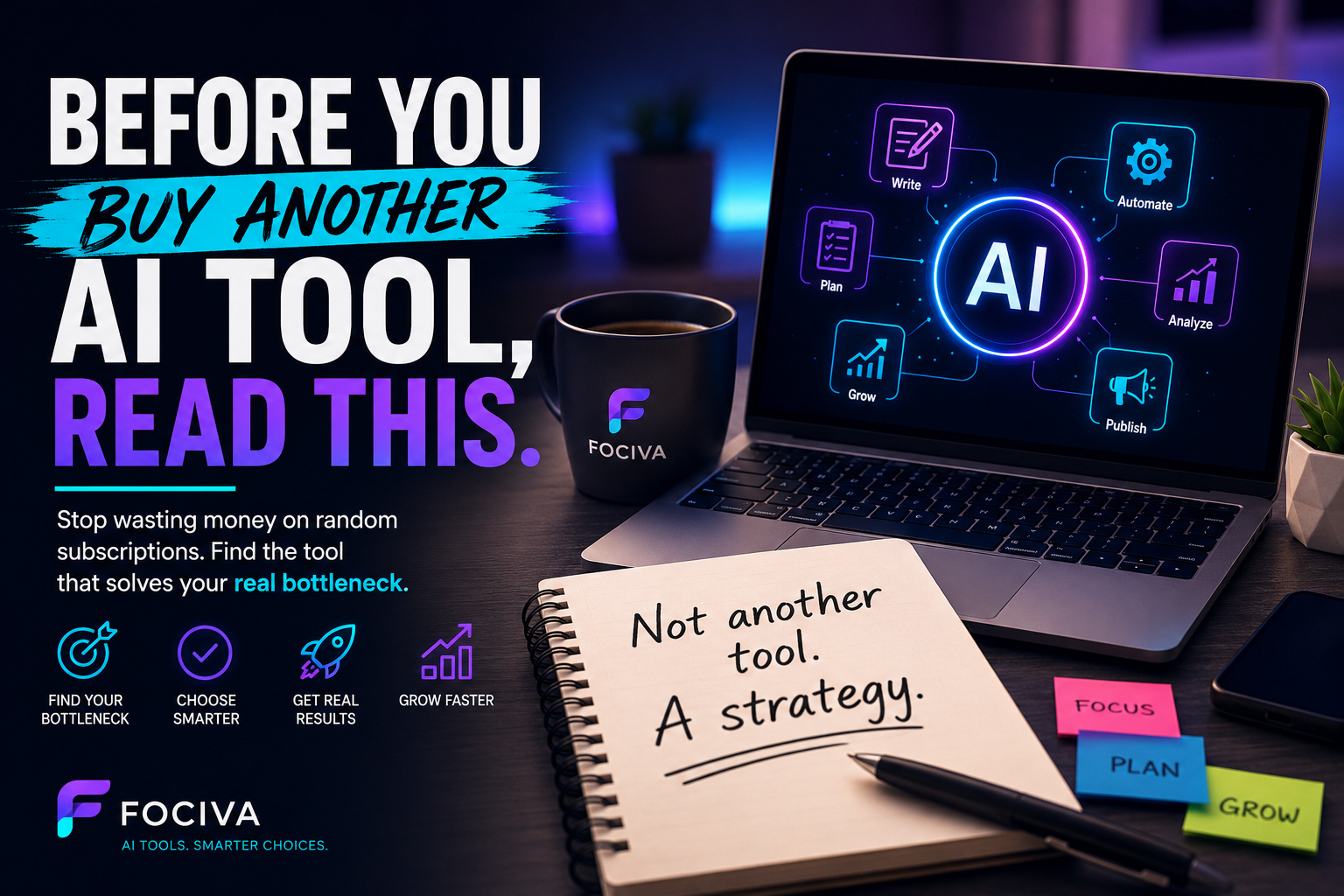
Before you buy another AI tool, be honest about what usually happens.
You see a clean demo. The tool looks sharp. The promise feels obvious: faster content, less work, better output, maybe even more money. So you try it.
For three days, it feels like progress.
Then the same problem is still there. The article is still not published. The traffic is still weak. The affiliate link still does not get clicks. The workflow still feels messy. The subscription is active, but the result is not.
That is the part most AI tool reviews skip.
The mistake is not always that you bought the wrong tool. A lot of tools are genuinely useful. The real mistake is buying the tool too early, before you know what job it is supposed to do.
That is what this guide fixes. Not with another giant list. Not with hype. Just a cleaner way to decide what should come first.
Find the AI tool you should buy first
Take the free 2-minute diagnostic before your next subscription. It gives you a bottleneck result and points you to the right Fociva guide for your situation.
Take the Free Diagnostic → See AI Assistant ToolsThe Costly Mistake Is Buying in the Wrong Order
Most beginners do not waste money because they are careless. They waste money because every tool looks useful when the real problem is not clear.
If content is slow, an automation platform looks exciting. If traffic is weak, a new AI writer looks tempting. If focus is broken, a shiny productivity app feels like a reset. If affiliate links do not convert, another content generator looks like the missing piece.
But a tool bought in the wrong order usually adds more moving parts. More logins. More dashboards. More “I should use this” guilt.
And still no result.
The Bottleneck Test: What Is Actually Costing You Money?
Before you compare pricing, lifetime deals, features, reviews, or bonuses, answer one uncomfortable question:
What is the real thing slowing this down?
Not the thing that feels annoying. The thing that is actually costing you output, traffic, clicks, focus, protection, or money.
| If this is your problem | What it looks like in real life | Do not buy this first | Buy or test this first |
|---|---|---|---|
| No content | You have ideas, but research, writing, editing, or publishing takes too long. | Advanced automation platform | AI writing, research, or content workflow tool |
| No traffic | You publish, but very few people find the article, pin, review, or offer. | Another writing app | SEO, keyword, Pinterest, or distribution tool |
| No clicks | You add links, but the page does not create enough trust or urgency to click. | More random buttons or banners | Comparison content, buyer guides, clearer CTA structure |
| No focus | You know what to do, but drift between tabs, tools, and unfinished tasks. | Another AI content tool | Focus, blocking, task, or productivity system |
| No protection | You work online, log into important accounts, or use public Wi-Fi without basic security. | Another productivity subscription | VPN, password manager, two-factor authentication setup |
| No system | You have tools, prompts, and ideas, but no repeatable path from idea to result. | More random apps | Simple workflow, checklist, or tool stack by goal |
The goal is not to stop buying tools. That would be useless advice. The goal is to stop buying tools that have no clear job.
What to Buy First If Content Is Too Slow
If content is the bottleneck, do not start with complex automation.
Start closer to the work. Research. Outline. Draft. Edit. Publish. That is where the friction usually lives.
A good content tool should make one of those steps noticeably easier. It should help you move from idea to usable draft faster. It should reduce blank-page friction. It should help you structure the article, clean up the writing, or turn one idea into more than one asset.
It does not need to be impressive. It needs to be used.
Content tool buying filter
- Does it help you create publishable content faster?
- Does it reduce the blank-page stage?
- Does it help with outlines, drafts, research, SEO structure, or rewriting?
- Can you realistically use it every week?
- Does it replace a real task, or does it just add another dashboard?
Need faster content creation?
Start with a content workflow tool before buying advanced automation. Faster draft-to-publish usually matters more than another dashboard.
Compare Personal AI Assistant Tools →What to Buy First If You Have No Traffic
If nobody sees the content, another writing tool may not solve the real problem.
This is where a lot of people get stuck. Creating feels productive, so they keep buying tools that help them create. But if the page has no search demand, no Pinterest angle, no internal links, and no reason to be discovered, publishing more will not automatically fix it.
Traffic is its own bottleneck.
That means the next useful tool may be about keywords, Pinterest SEO, topic clusters, internal linking, search intent, or distribution. Less “write faster,” more “publish where demand already exists.”
Traffic tool buying filter
- Does it show what people are already searching for?
- Does it help you choose topics with actual demand?
- Does it improve internal links, topical structure, or search visibility?
- Does it help you publish with a traffic path, not just a finished article?
If traffic is the bottleneck, buy for visibility first
Start with tools and workflows that help people actually find your content before you add more writing apps to the stack.
See AI Search Optimization Tools →What to Buy First If Your Affiliate Links Do Not Convert
If your affiliate links do not convert, the link is usually not the real problem.
The problem is what happens before the link.
Does the reader understand the problem? Do they trust the page? Do they know who the tool is for? Do they see why this option fits their situation? Or did you just add a button and hope the click would happen?
Cold readers rarely click because a link exists. They click when the page makes the next step feel obvious.
That may mean your buying priority is not another AI writing app. It may be better comparison pages, sharper CTA blocks, clearer product positioning, stronger buyer guides, or a quiz that diagnoses the visitor before recommending a tool.
Affiliate conversion buying filter
- Does the page explain who the tool is for?
- Does it say who should skip it?
- Does the CTA match the reader’s problem?
- Is the tool recommended as a solution, or just dropped as a link?
- Does the page help the reader make a decision?
If links are not converting, fix the trust path first
Random affiliate links rarely convert cold readers. Build the page so the reader understands the problem, the use case, and the next step.
See AI Affiliate Programs →What to Buy First If You Cannot Stay Focused
If focus is the bottleneck, another AI tool can make the situation worse.
Not because the tool is bad. Because it gives you more options when you already have too many open loops.
If you start five tasks, jump between tabs, leave drafts unfinished, and keep restarting the same plan every week, the first tool you need may not be a content generator. It may be a focus tool, blocker, task structure, or simple work-session system.
A focus tool is not exciting. But finishing more work is usually more valuable than adding another shiny app.
Focus tool buying filter
- Does it reduce distractions during real work sessions?
- Does it make time, tasks, or priorities more visible?
- Does it help you finish, not just start?
- Can it support your work without becoming another complicated system?
If focus is the bottleneck, simplify the workday first
Look at productivity tools that help you finish tasks before you add another AI app to the pile.
See AI Productivity Tools →What to Buy First If You Work Online and Are Not Protected
If you work online, your accounts are part of the business.
WordPress. Email. Affiliate dashboards. Payment accounts. Banking tools. Cloud storage. Client platforms. Lose access to one of those, and the damage is not theoretical anymore.
If you regularly work from cafes, hotels, airports, coworking spaces, or shared Wi-Fi, basic security is not a “later” task. It belongs in the setup.
In that case, a VPN or basic security stack may matter more than another productivity subscription.
Security buying filter
- Do you use public or shared Wi-Fi?
- Do you log into website, email, money, or affiliate accounts online?
- Do you reuse passwords or skip two-factor authentication?
- Would losing access to your accounts cost you time or money?
For basic online account protection, you can also review general security guidance from CISA Secure Our World and password safety advice from Google Account Help.
Protect the online setup you are building
If you work from public Wi-Fi or manage important online accounts, compare beginner-friendly security tools before adding more apps to your stack.
Compare Best VPN Services →The AI Tool Buyer’s Matrix
Use this before buying another subscription. It is simple on purpose.
| Bottleneck | First tool type to consider | What success should look like | When to skip |
|---|---|---|---|
| Content is too slow | AI writing, research, or SEO content tool | You publish faster with less blank-page friction. | Skip if you already publish consistently but have no traffic. |
| No traffic | Keyword, Pinterest, SEO, or distribution tool | More content is built around real search or discovery demand. | Skip if you have no content foundation yet. |
| No clicks or sales | Buyer guides, comparison pages, quiz, CTA system | Readers understand the problem and click with clearer intent. | Skip if you barely have traffic yet. |
| No focus | Focus, task, blocker, or workflow tool | You finish more of the work you start. | Skip if your main issue is lack of demand or a weak offer. |
| Security risk | VPN, password manager, 2FA setup | Your accounts and connections are better protected. | Skip as first priority if you never work on shared networks and already have strong account security. |
The 5 Questions to Ask Before You Pay
Before you buy another AI tool, ask these five questions in order:
- What bottleneck does this tool remove?
- Will I use it every week?
- Does it save time, create traffic, improve focus, increase trust, or protect my work?
- What task will this tool replace or improve?
- What will I stop doing because this tool exists?
If you cannot answer those questions, do not buy yet.
If you can answer them clearly, then you are no longer buying because of hype. You are buying because the tool has a job.
Before you buy another AI tool, come back to the same question: will this tool help you create faster, get traffic, improve focus, increase trust, or protect your online work?
Take the diagnostic before your next AI tool purchase
The AI Tool Buyer Diagnostic helps you diagnose your bottleneck and choose what to buy first without adding another random subscription to your stack.
Take the Free Diagnostic → See AI Affiliate ProgramsFinal Verdict
The best AI tool is not the one with the loudest launch or the most impressive demo.
The best AI tool is the one that fixes the bottleneck currently costing you time, clicks, focus, protection, or money.
If you have no content, buy for content speed. If you have no traffic, buy for visibility. If you have no clicks, fix the trust path. If you cannot focus, buy structure before more AI. If you work online without protection, fix security before adding another productivity app.
Do not buy tools because they look powerful.
Buy the one that has a clear job in your system.
Frequently Asked Questions
What should I check before buying an AI tool?
Before buying an AI tool, identify the bottleneck you want to fix. Ask whether the tool will save time, improve content, help with traffic, support focus, increase trust, or protect your online work. If you cannot name the problem clearly, wait before buying.
Why do beginners waste money on AI tools?
Beginners often waste money because they buy tools before they know the job the tool needs to do. Even a useful app becomes wasted money if it does not solve the current bottleneck.
What AI tool should I buy first?
The first tool depends on your bottleneck. If content is slow, start with a writing or research tool. If traffic is weak, consider SEO or discovery tools. If you cannot focus, start with a productivity system. If you work online from shared networks, consider a security setup.
Are AI tools worth paying for?
AI tools are worth paying for when they have a clear role in your workflow and you use them consistently. They are not worth it when they overlap with tools you already own or when you buy them only because they are trending.
Should I buy multiple AI tools at once?
Most beginners should avoid buying multiple tools at once. Start with the tool that solves the biggest bottleneck first. Add more tools only when each one has a specific role in your workflow.